
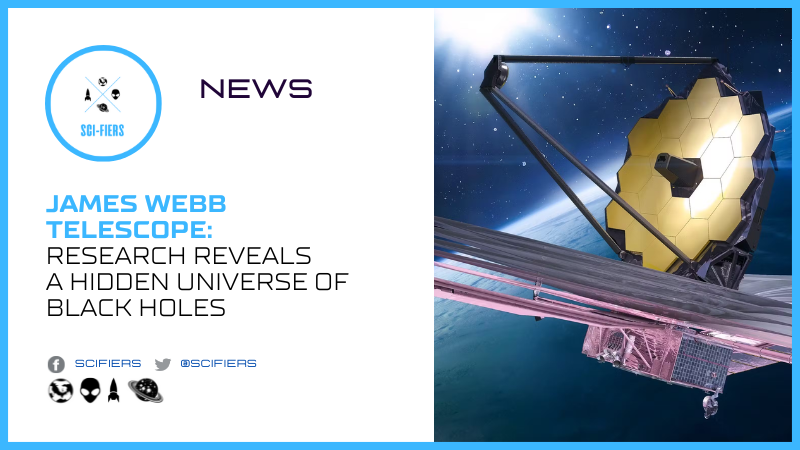
Astronomers using the James Webb Space Telescope (JWST) have uncovered a mysterious new class of supermassive black holes—hidden behind thick cosmic dust in the early universe.
These elusive giants bridge the gap between blazing quasars and the enigmatic “Little Red Dots”—faint, dust-shrouded objects recently detected near the dawn of time. While classical quasars are bright and easily spotted, these newly discovered black holes are just as powerful but obscured, making them nearly invisible to earlier telescopes.
The breakthrough came when scientists combined data from Hawaii’s Subaru Telescope with JWST’s unmatched sensitivity. Out of 13 ancient galaxies studied, nine revealed fast-moving gas—clear evidence of hidden supermassive black holes at their cores.
“We were stunned to find so many obscured quasars,” said lead researcher Yoshiki Matsuoka. “This means we’ve missed a huge population of black holes in past surveys.”
The discovery could reshape our understanding of how these cosmic monsters grew so quickly after the Big Bang. Next, astronomers will hunt for more of these hidden giants—and perhaps finally solve the puzzle of the Little Red Dots.
Scifiers explores science fiction narratives that enliven our imagination and compel us to think about the “what-ifs” of creative world-building. It is on a mission to discuss ideas about sci-fi in its various forms that keep the genre in a state of continuous expansion.
facebook.com/scifiers