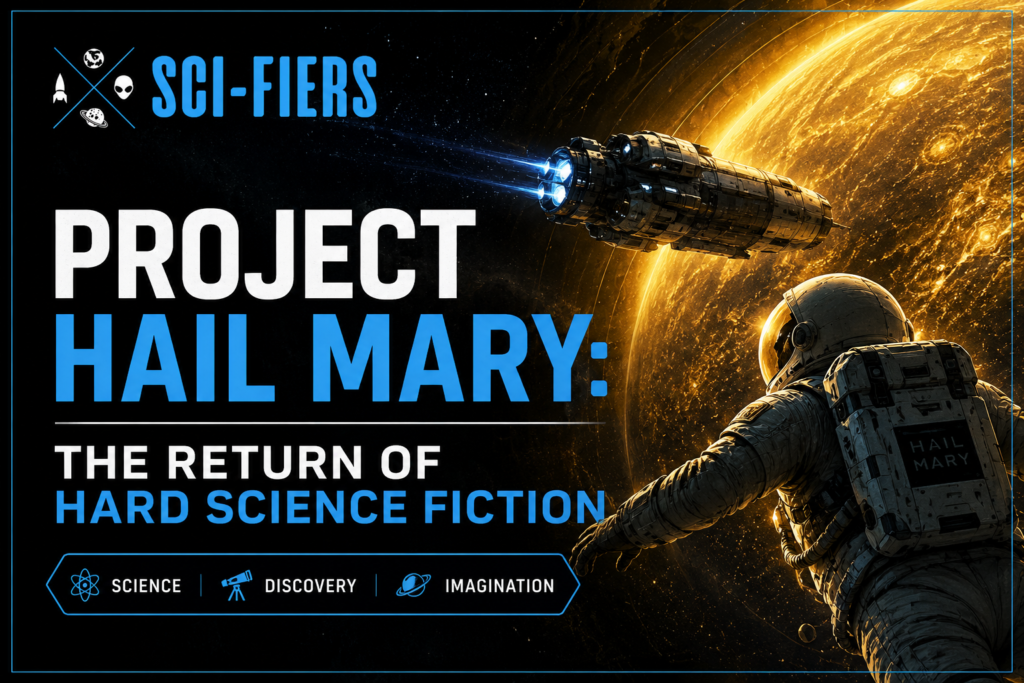
Science fiction has always fascinated me because it asks a simple question: “What if?” This is also the premise why I began this website in the first place. It brings me closer to the very foundations of science fiction and why I became a sci-fi author. What if we could travel to distant stars? What if we encountered alien life? What if science became humanity’s only hope for survival? Andy Weir’s Project Hail Mary takes these questions and transforms them an enjoyable hard science fiction novels of recent years.
At first glance, the novel seems straightforward. Ryland Grace wakes up alone aboard a spacecraft with no memory of who he is or why he is there. Gradually, he discovers that Earth faces an extinction-level crisis and that he has been sent on a desperate mission to save humanity. What follows is a thrilling journey filled with scientific puzzles, unexpected discoveries, and moments of genuine wonder.
What makes Project Hail Mary stand out is its commitment to science. Unlike many science fiction stories that use technology as a plot device, Weir links his narrative in real scientific principles. Physics, chemistry, biology, and astronomy are not merely elements in the story; they drive the plot. Every obstacle Grace encounters requires logic, experimentation, and problem-solving rather than wonders, miracles or fiction.
This is what defines hard science fiction. The genre emphasizes scientific accuracy and plausible technology while exploring how humans respond to extraordinary circumstances. Readers are not spectators. They become participants, following the protagonist’s reasoning and attempting to solve problems alongside him.
Yet scientific detail alone does not explain the novel’s popularity. Plenty of technically accurate books fail to capture readers’ imagination. Project Hail Mary succeds because it combines intellectual curiosity with emotional depth. Beneath the equations and experiments lies a story about friendship, sacrifice, resilience, and hope.
One of the novel’s greatest strengths is its ability to make complex scientific concepts accessible without feeling like a textbook. Weir has a talent for explaining difficult ideas through humor and relatable examples. The result is a book that appeals not only to science enthusiasts but also to general readers.
The success of Project Hail Mary highlights something important about contemporary science fiction. Readers still crave stories that respect intelligence and celebrate discovery. In an era dominated by dystopian narratives and superhero spectacles, there remains a strong appetite for stories where knowledge matters and science offers solutions rather than threats. Perhaps that is why hard science fiction continues to endure. It reminds us that curiosity is one of humanity’s greatest strengths. It encourages us to imagine futures shaped not by magic but by innovation, determination, and a willingness to explore the unknown.
Scifiers explores science fiction narratives that enliven our imagination and compel us to think about the “what-ifs” of creative world-building. It is on a mission to discuss ideas about sci-fi in its various forms that keep the genre in a state of continuous expansion.