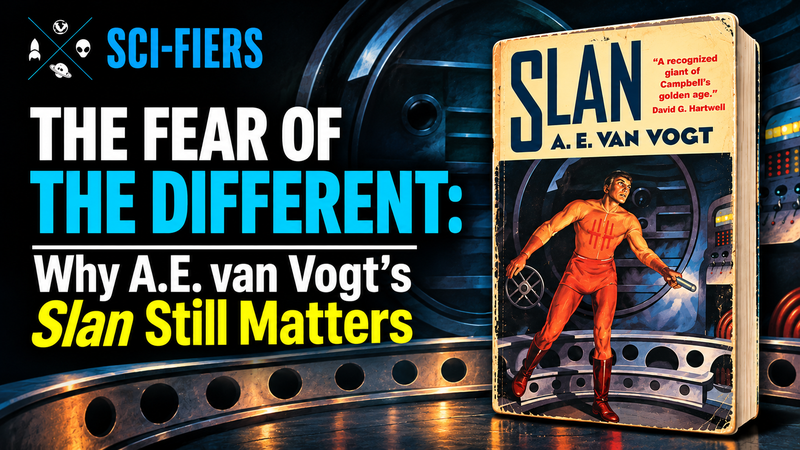

Published in 1940, A.E. van Vogt’s Slan is more than a science fiction novel about an advanced human species. It is a story about prejudice, fear, persecution, and the treatment of those who are different from the majority. Although written more than eight decades ago, its central ideas remain relevant today.
The novel introduces a world in which Slans are a superior species with extraordinary mental abilities. However, instead of being admired for their intelligence, they are feared and hunted by ordinary, normal-looking humans. Their differences make them targets of suspicion and violence. This creates an interesting contradiction: a species that possesses greater abilities is still vulnerable because society refuses to accept it.
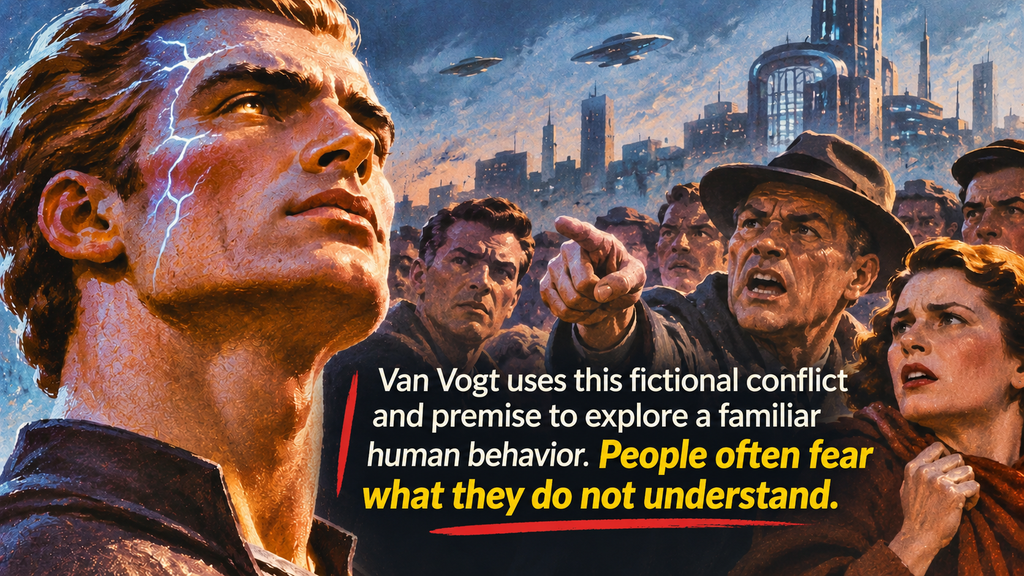
Van Vogt uses this fictional conflict and premise to explore a familiar human behavior. People often fear what they do not understand. Differences in appearance, beliefs, language, ethnicity, or abilities can become reasons for discrimination. History offers countless examples of communities being marginalized because they do not fit into the prevailing social structure.
This is where Slan becomes an interesting read. Its fictional narrative can be read as an allegory of racism, social exclusion, and the misuse of power. The novel also talks about why does being different make someone a threat, or does society create that threat through its own prejudice? Perhaps humanity has advanced technologically but not socially. We have learned to explore space and develop artificial intelligence, but accepting someone who is different remains a challenge.
That is why Slan still matters. It reminds us that the real test of an advanced civilisation is not how intelligent or powerful it becomes, but how it treats those who are different.
Scifiers explores science fiction narratives that enliven our imagination and compel us to think about the “what-ifs” of creative world-building. It is on a mission to discuss ideas about sci-fi in its various forms that keep the genre in a state of continuous expansion.